

Cornwall Living
Shelters for the senses
This summer, Tate St Ives presents the first UK museum exhibition dedicated to Lithuanian American artist Aleksandra Kasuba. Spanning seven decades, the show traces her evolution from early paintings and mosaics to ambitious sculptures and immersive spatial environments that reimagined how people might inhabit space.
Born in Lithuania in 1923, Kasuba fled successive Soviet and Nazi occupations in 1944, later emigrating to the United States. In New York she established a reputation for monumental public commissions, including works in Washington DC, Chicago and at the World Trade Center. Yet it was her radical environments of the 1970s that defined her vision. Inspired by shells, rock formations and marine life, she rejected rigid architecture in favour of tensile fabric structures without right angles, seeking a more harmonious relationship between people and their surroundings. As she told The New Yorker in 1971, she wanted to “kill the square”.
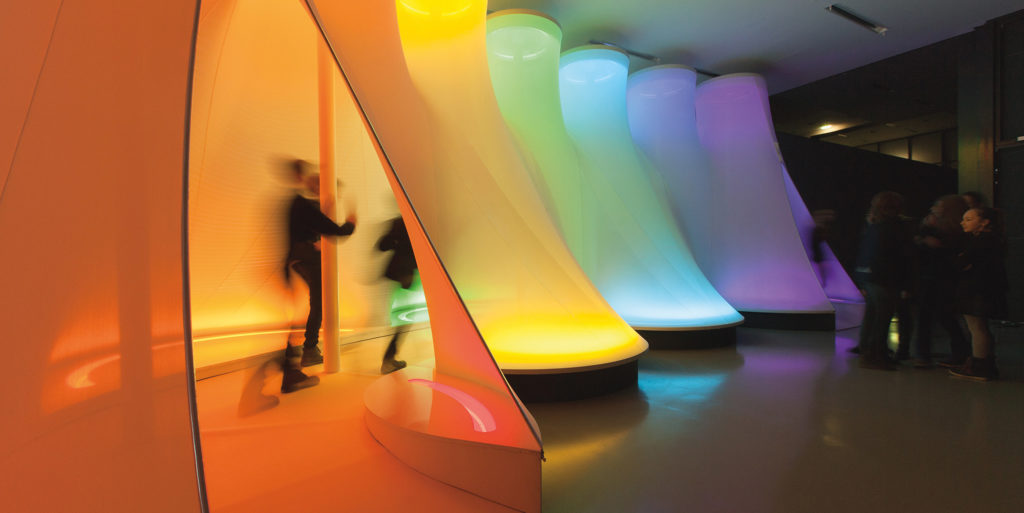
The exhibition includes Spectrum: An Afterthought (1975), a vivid passageway of coloured zones constructed from aluminium, neon and stretched fabric, accompanied by sound and scent to heighten its sensory impact. Also featured is Three-dimensional Rug (1971), part of a partial recreation of her New York Live-In Environment, alongside sculptures, drawings and models from the Lithuanian National Museum of Art.
Aleksandra Kasuba: Shelters for Senses reveals a pioneering figure whose utopian experiments in art and architecture feel strikingly timely today.
For more information, visit
tate.org.uk or call 020 7887 8888.